

IN SYNC, NO BUILD
EVER WAITS ON A
DRAWING.
IN SYNC, NO BUILD
EVER WAITS ON A
DRAWING.
PROJECT
SYNC- AI Workflow app
ROLE
Product Designer · UX · AI Product Development
INDUSTRY
Architecture & Interior Design
YEAR
2026
( WORK 04)
( WORK 04)
PRODUCT DESIGN
PRODUCT DESIGN
WEB APP
WEB APP
SYNC
SYNC
Architecture and interior design projects are shaped by constantly evolving site schedules, deadlines, and interdependent tasks. SYNC explores how AI can help design teams anticipate what needs to be prepared next before a site requirement turns into a last-minute drawing request.
The product concept is informed by my experience working as an architect and is designed for architecture and interior design firms seeking a more proactive approach to project coordination.
Architecture and interior design projects are shaped by constantly evolving site schedules, deadlines, and interdependent tasks. SYNC explores how AI can help design teams anticipate what needs to be prepared next before a site requirement turns into a last-minute drawing request.
The product concept is informed by my experience working as an architect and is designed for architecture and interior design firms seeking a more proactive approach to project coordination.
INDUSTRY
Architecture & Interior design studios
Architecture & Interior design studios
BUILT WITH
BUILT WITH
Google AI studio
Google AI studio
SERVICES
SERVICES
UX RESEARCH
UX RESEARCH
PRODUCT DESIGN
PRODUCT DESIGN
DESIGN SYSTEM
DESIGN SYSTEM
GEMINI
GEMINI
GOOGLE AI STUDIO
GOOGLE AI STUDIO
CONTEXT
CONTEXT
Developed as the capstone project for the Google AI Professional Certificate on Coursera, using Google AI Studio to take the concept from problem framing and product design to a working AI-powered web application.
↳
VIEW LIVE PROJECT
VIEW LIVE PROJECT
(OVERVIEW)
(OVERVIEW)
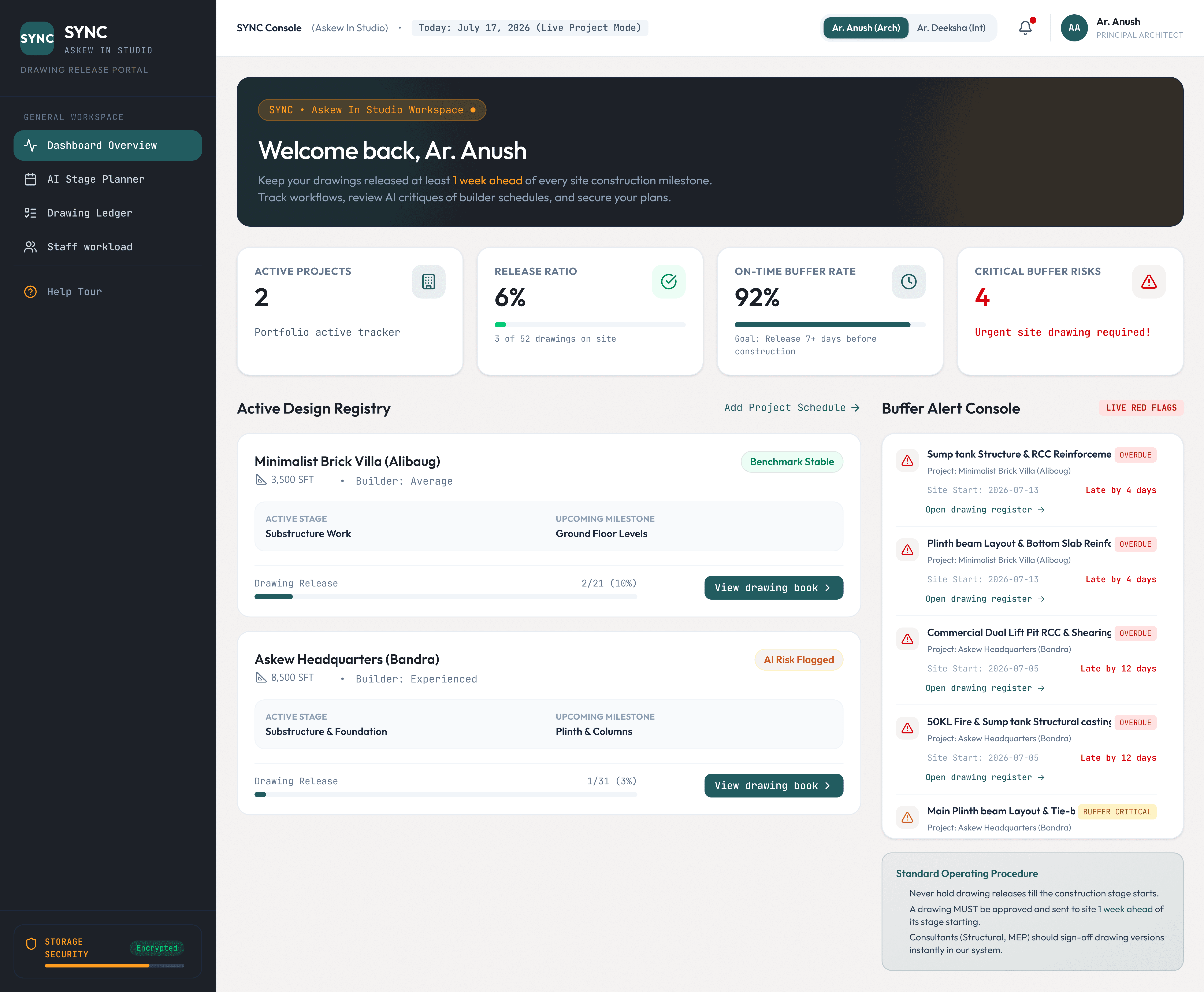
Having worked in architecture, I saw how often design teams were left reacting to changes on site. A shift in the construction schedule could quickly become a last minute drawing request. SYNC explores how AI can help teams stay ahead by connecting project schedules with the design work that needs to happen next.
I designed and built the product in Google AI Studio as the capstone for the Google AI Professional Certificate on Coursera, taking it from an industry problem to a working AI powered web app.
Having worked in architecture, I saw how often design teams were left reacting to changes on site. A shift in the construction schedule could quickly become a last minute drawing request. SYNC explores how AI can help teams stay ahead by connecting project schedules with the design work that needs to happen next.
I designed and built the product in Google AI Studio as the capstone for the Google AI Professional Certificate on Coursera, taking it from an industry problem to a working AI powered web app.
(THE CHALLENGE)
(THE CHALLENGE)
Three connected problems were making project coordination reactive.
1. Timing was disconnected.
Construction schedules showed when work would happen on site, while design teams worked to their own drawing deadlines. There was no clear connection between the two, leaving teams to work out priorities manually.
2. Information was fragmented.
Architecture, interiors, and consultants often worked across different tools, files, and versions. There was no shared view of what was ready, what was changing and what was still at risk.
3. Workload was hard to see.
Much of the team’s workload lived in spreadsheets, inboxes, and people’s heads. By the time an overloaded team member was identified, a deadline had often already been missed.
The problem was not simply getting drawings out. It was having the right visibility early enough to act.
Project coordination was often reactive. Construction schedules, design deadlines, consultant updates, and team workloads lived across different tools, making it difficult to see what needed attention and when. By the time a delay became visible, the team was already catching up. The real challenge was not producing drawings, but having the right visibility early enough to act.
Project coordination was often reactive. Construction schedules, design deadlines, consultant updates, and team workloads lived across different tools, making it difficult to see what needed attention and when. By the time a delay became visible, the team was already catching up. The real challenge was not producing drawings, but having the right visibility early enough to act.
(THE APPROACH)
(THE APPROACH)
I designed SYNC around a simple idea: give design teams enough visibility to act before a project falls behind. Instead of treating site schedules, drawing deadlines and team workload as separate pieces of information, the product brings them together into one connected workflow.
The core experience is built around three areas. Planning uses AI to interpret construction schedules and translate site activity into realistic design deadlines. Release tracking gives the team a clear view of drawing versions, status and upcoming deliverables. Workload visibility helps surface capacity issues early, so teams can understand where work is building up before it affects a deadline.
The challenge was to make all of this feel useful without making the interface feel complex. I kept the experience focused on the information people need to make decisions, using clear hierarchy, restrained visual language and purposeful use of colour to bring attention to changes, risks, and actions.
The result is a workflow that shifts the team from asking, “What have we missed?” to “What needs to happen next?”
I designed SYNC to bring project schedules, drawing deadlines, and team workload into one connected workflow. AI helps translate site activity into actionable design deadlines, while the product gives teams a clear view of upcoming releases, capacity, and potential bottlenecks. The experience is intentionally simple and focused, using clear hierarchy and subtle visual cues to surface what needs attention and help teams act before delays happen.
I designed SYNC to bring project schedules, drawing deadlines, and team workload into one connected workflow. AI helps translate site activity into actionable design deadlines, while the product gives teams a clear view of upcoming releases, capacity, and potential bottlenecks. The experience is intentionally simple and focused, using clear hierarchy and subtle visual cues to surface what needs attention and help teams act before delays happen.
(RESULTS & IMPACT)
(RESULTS & IMPACT)
SYNC turns project risk into something teams can see and act on earlier. By bringing release progress, schedule buffers, and workload into one view, it creates a shared understanding of what needs attention and where delays may emerge.
The biggest shift is from reacting to missed deadlines to anticipating them. Instead of discovering a problem on site, teams can see what is at risk, understand why, and act before it becomes a delay. The project demonstrates how AI can bring greater clarity and predictability to a traditionally reactive design workflow.
SYNC turns project risk into something teams can see and act on earlier. By bringing release progress, schedule buffers, and workload into one view, it creates a shared understanding of what needs attention and where delays may emerge.
The biggest shift is from reacting to missed deadlines to anticipating them. Instead of discovering a problem on site, teams can see what is at risk, understand why, and act before it becomes a delay. The project demonstrates how AI can bring greater clarity and predictability to a traditionally reactive design workflow.
SYNC turns project risk into something teams can see and act on earlier. By bringing release progress, schedule buffers, and workload into one view, it creates a shared understanding of what needs attention and where delays may emerge.
The biggest shift is from reacting to missed deadlines to anticipating them. Instead of discovering a problem on site, teams can see what is at risk, understand why, and act before it becomes a delay. The project demonstrates how AI can bring greater clarity and predictability to a traditionally reactive design workflow.


© 2026 Anush, All rights reserved.
© 2026 Anush, All rights reserved.
